Hips
Geared, back-drivable
Steadywin GIM3505-8 with an 8:1 gearbox and its own driver. Three M2.5 × 8 screws hold each stator to its side yoke.
A balancing robot printed in carbon-fibre nylon, with legs that step and a head you can swap.
Two hub-motor wheels keep it upright. Two geared hip motors fold four-bar legs to crouch, ride over steps and jump. Every structural part comes off a desktop printer. The only bought metal is screws, bearings and the motors themselves.
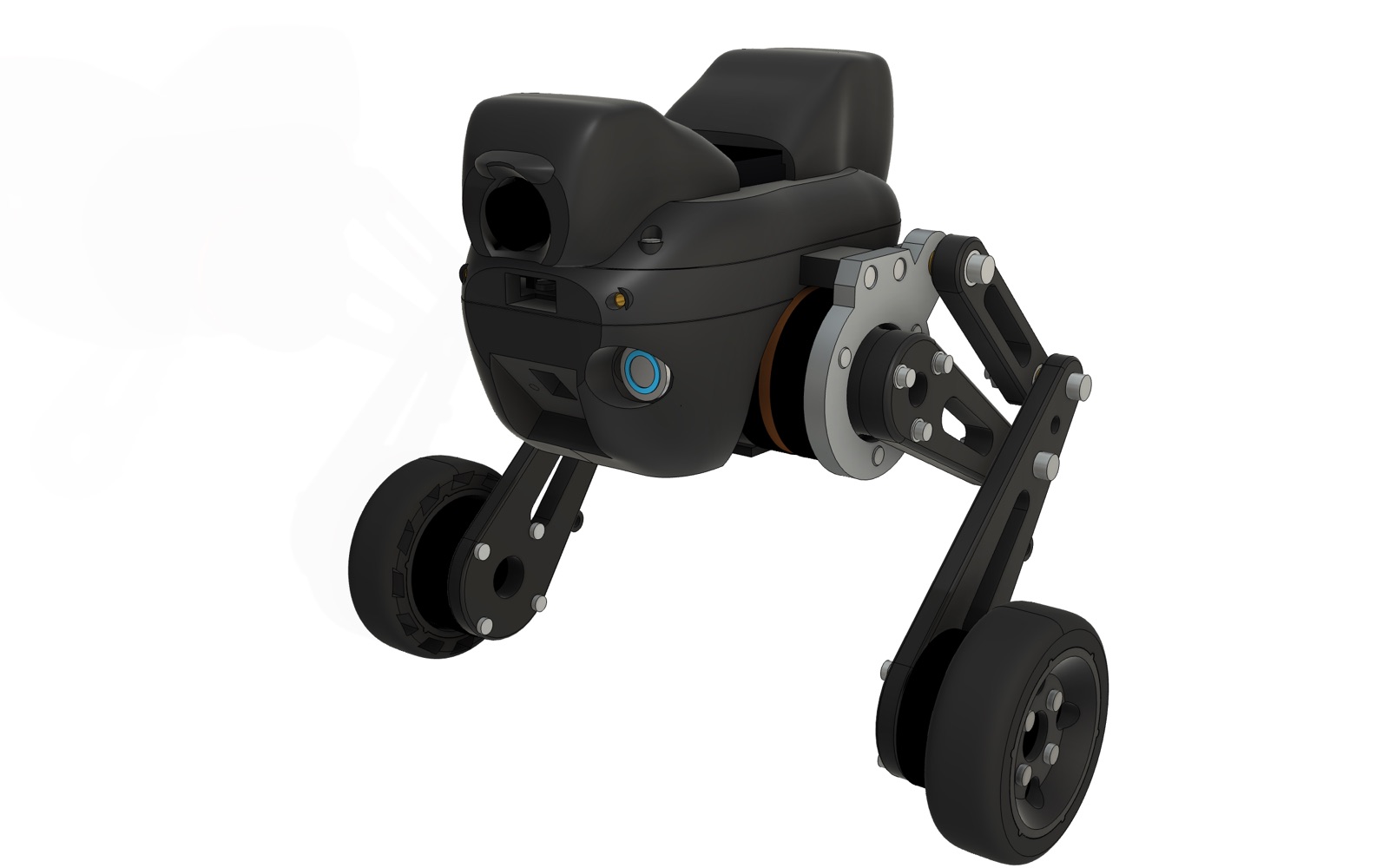
The Fusion assembly has 187 bodies in the base robot: motors, boards, bearings, heat-set inserts and every fastener at its catalogue length. Each camera head is checked against the base for collisions before it is exported for printing. The current revision has none.
Only the canopy changes between builds. Camera heads are printed at a fixed tilt. You choose the angle by printing that version, so nothing can slip after a hard landing.
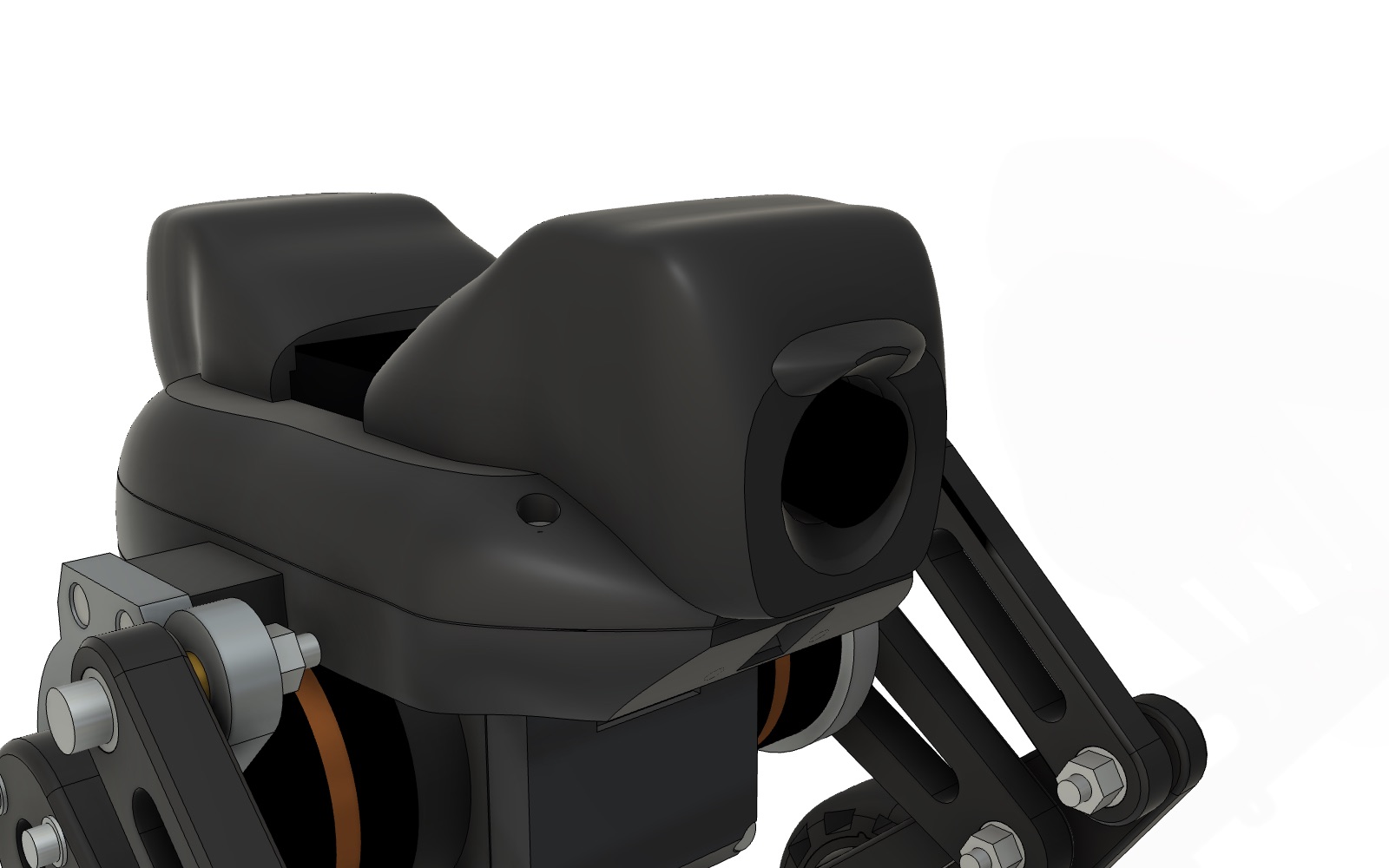
A Teensy 4.1 runs the balance loop and commands all four motors on one CAN bus. An optional Raspberry Pi CM5 handles the cameras. Every motor has its own driver built in, so the power path inside the body is just a switch, a capacitor and a clamp.
Steadywin GIM3505-8 with an 8:1 gearbox and its own driver. Three M2.5 × 8 screws hold each stator to its side yoke.
The DD4006-7 pancake motor is the wheel hub. A TPU tyre presses over the printed rim, so there is no gearbox to backlash.
A hard landing pushes energy back into the bus. Above 26.2 V a TL431 opens a MOSFET into a 5 W resistor, which keeps the bus under the wheel motors' 28 V limit. In standby it draws about 1 mA.
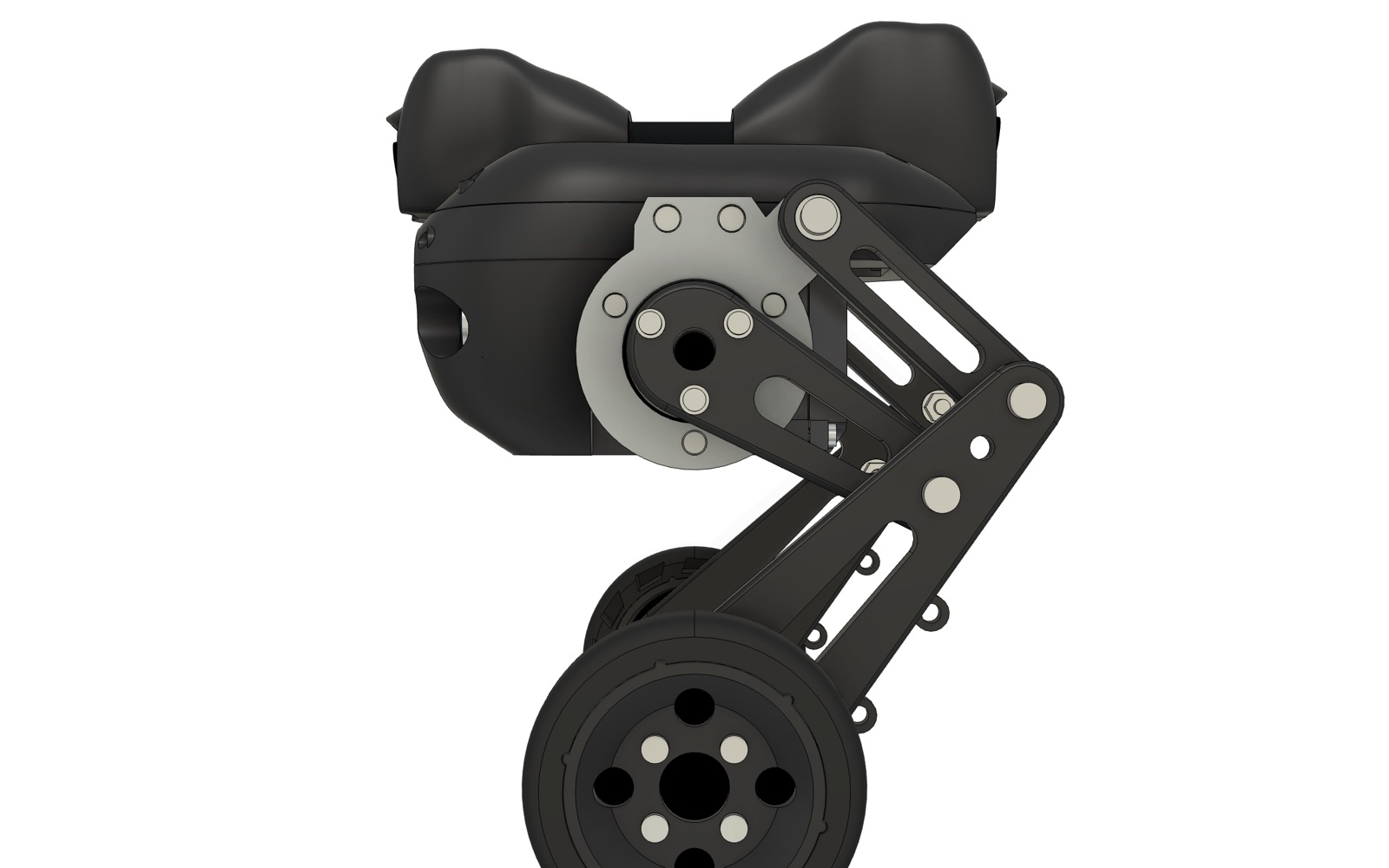
The hip motor turns the thigh. A coupler from the body to the shank keeps the wheel travelling almost straight down as the leg folds, so crouching changes ride height without rolling the robot forward.
| Pin | Joins | Hardware, per side |
|---|---|---|
| C1 | Body → coupler | 2 × 684ZZ, M4 × 25, DIN 985 nut |
| Knee | Thigh → shank | 2 × 684ZZ, M4 × 25, DIN 985 nut |
| C2 | Coupler → shank | 2 × 684ZZ, M4 × 25, DIN 985 nut |
Print with a hardened 0.4 mm nozzle. Each part ships pre-oriented for the plate. Every screw that comes out more than once goes into a brass heat-set insert, so the threads never wear into the plastic.
Pelvic pod, avionics deck and both wheel hubs. Tree supports.
Thighs, shanks, couplers, side yokes, spacers and the battery cartridge. Printed flat, no supports.
Two tyres in flexible TPU 95A that press over the hub-motor rims.
One folder per head: flat lid with roof plug, Head A or Head B at your chosen tilt.
Printed parts are computed from CAD volume at 1.25 g/cm³ for PA-CF. Whole-robot figures are estimates until the first build goes on a scale.