FLAT LID · NO COMPUTE
Base
Flat lid
A low lid plus a printed roof plug where the compute module would sit. The robot runs on the Teensy alone: balancing, driving and learning-controller experiments.
lid 20 groof plug 11 gno CM5
REX Variant Q is a two-wheeled, two-legged robot built entirely from 3D-printed carbon-fibre nylon, off-the-shelf actuators and hobby electronics. There are no CNC parts. Four-bar legs carry it over steps, a 6S battery gives it jumping power, and a swappable head turns it from a bare balancing platform into a dual-camera visual-inertial scout.
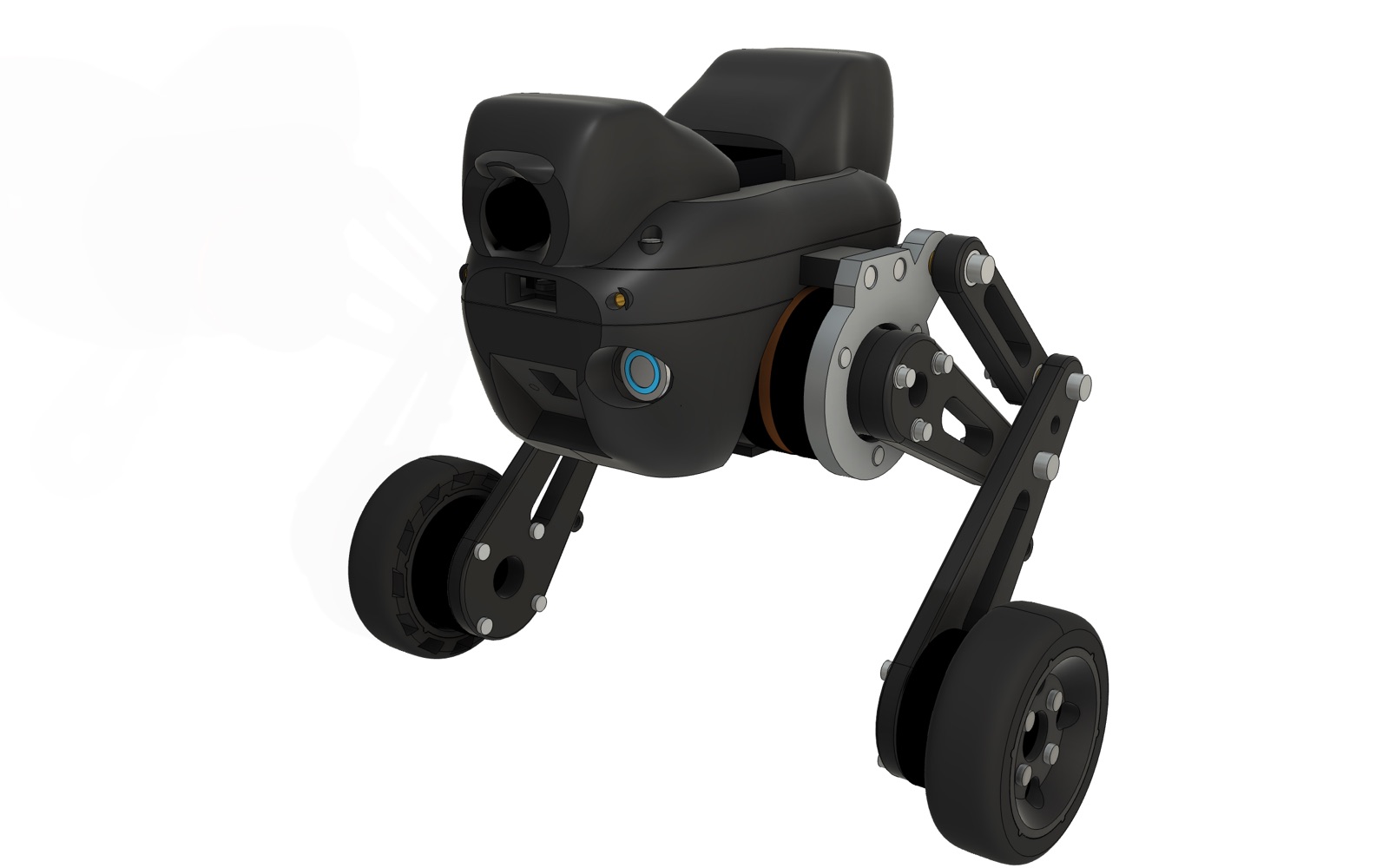
The full assembly lives in a single Fusion model: 180+ bodies including motors, PCBs, bearings, heat-set inserts and every fastener at its real length, checked for interference before anything is printed.
The canopy is the only part that changes between configurations. Camera heads come pre-angled at 0°, 10°, 20° (and 30° for the top domes). Instead of an adjustable mount you print the angle you want, so nothing can drift loose after a hard landing.
A low lid plus a printed roof plug where the compute module would sit. The robot runs on the Teensy alone: balancing, driving and learning-controller experiments.
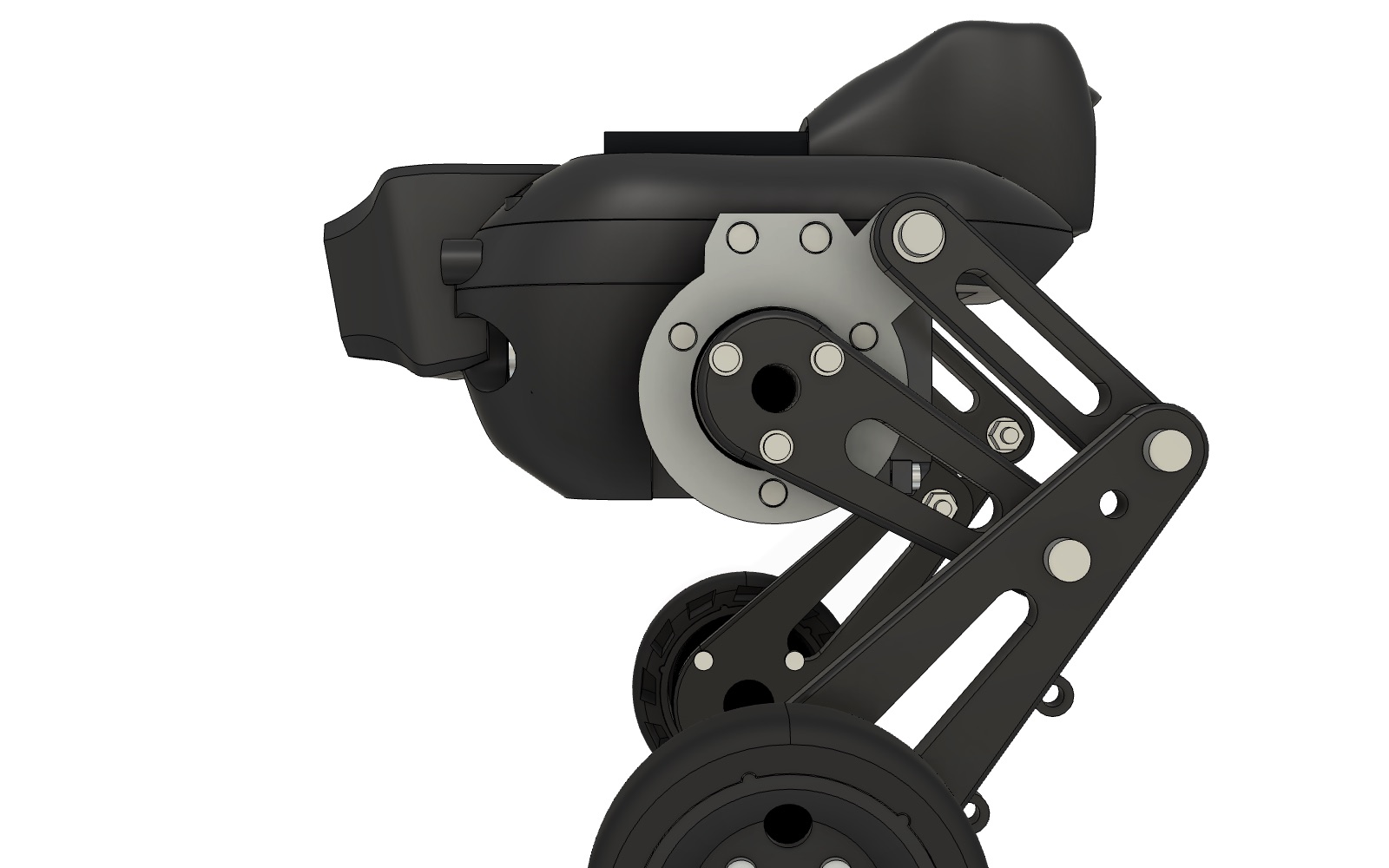
The forward camera rides low in a nose pod for a road-level view. A second camera looks backwards from a dome on the canopy. Together they give dual visual-inertial odometry.
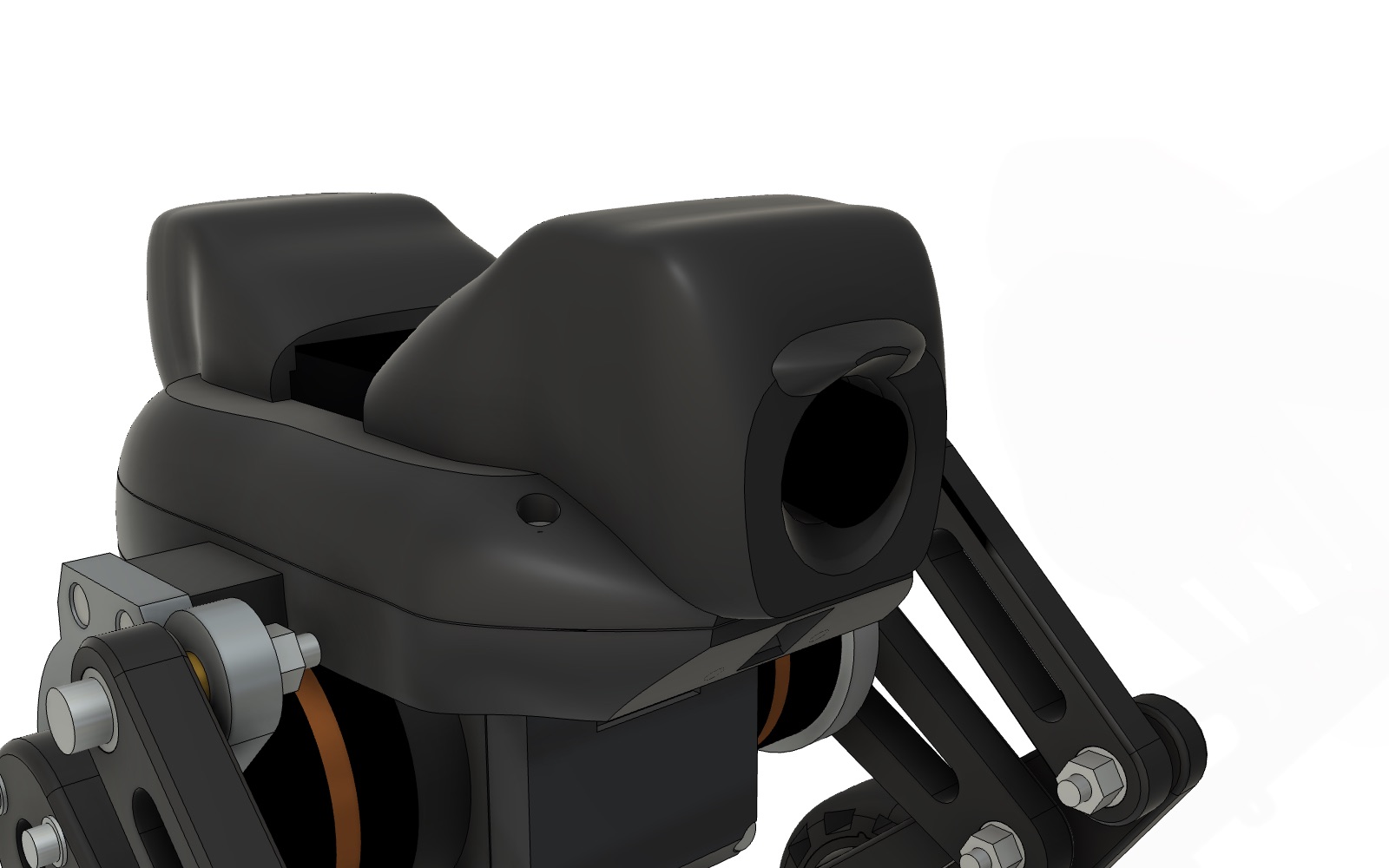
Both cameras sit high in sculpted domes, front and rear. This gives the widest view over obstacles. Each camera clips into a 5 g printed carrier locked by two screws.
Camera heads need the Raspberry Pi CM5 that processes the video. The roof plug is printed only for the flat-lid build.
A Teensy 4.1 runs the real-time balance loop and talks to all four motors over one CAN bus. An optional Raspberry Pi CM5 handles vision. Each actuator has its own field-oriented driver built in, so the main board has no power electronics apart from the switch and the bus protection.
Steadywin GIM3505-8 gearmotors drive the hips. Pancake DD4006-7 hub motors sit inside the tyres. All four take commands over a single CAN bus.
A thigh, coupler and shank keep the wheel moving almost vertically as the hip turns. Each joint runs on a pair of 684ZZ bearings and an M4 axle with a locknut.
Hard landings push regenerated energy back into the bus. A TL431-controlled MOSFET dumps it into a 5 W resistor at 26.2 V, so the bus stays below the wheel motors' 28 V limit. In standby it draws only about 1 mA through its sense divider.
Everything structural is printed on a desktop printer with a hardened nozzle. Brass heat-set inserts hold every screw that comes out more than once, so the threads never wear the plastic.
Pelvic pod, avionics deck and wheel hubs in PA-CF, printed with tree supports.
Thighs, shanks, couplers, side yokes and battery cartridge. Printed flat, no supports.
Two TPU 95A tyres pressed over the hub-motor rims.
Choose a flat lid, Option A or Option B at the camera angle you want.
The printed parts are computed from the CAD volumes at a PA-CF density of 1.25 g/cm³. The whole-robot figure is an estimate until the robot is weighed.
| Printed part | g |
|---|---|
| Pelvic pod | 64.8 |
| Avionics deck | 32.6 |
| Shanks (2) | 44.6 |
| Thighs (2) | 33.6 |
| Wheel hubs (2) | 25.3 |
| Side yokes (2) | 23.2 |
| Flat lid + roof plug | 30.9 |
| Couplers, cartridge, clamp | 21.3 |
| TPU tyres (2) | 42.2 |
| Printed total (flat-lid build) | 318.4 |
| Configuration | Estimate |
|---|---|
| Flat lid, Teensy only | ~910 g |
| Camera head (A or B), dual VIO + CM5 | ~1010 g |